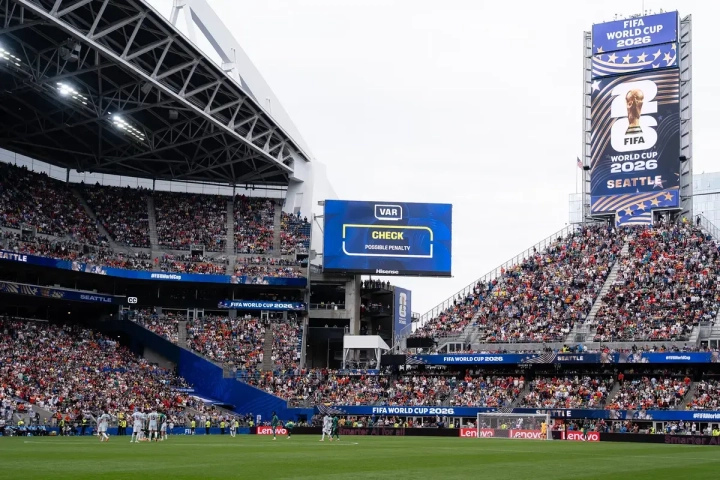
The 2026 FIFA World Cup was billed as the dawn of a new era. With an expanded 48-team format spanning the United States, Canada, and Mexico, the tournament promised an unprecedented festival of global football. Yet, as the dust settles on the group stages and the Round of 32 delivers its brutal knockout blows, the primary talking point in bars, living rooms, and press conferences around the world is not a spectacular goal or a breakout prodigy. Instead, it is an acronym that continues to divide the sport: VAR.
This summer, FIFA rolled out its most advanced technological arsenal to date. The introduction of the Adidas Trionda match ball, complete with internal IMU (Inertial Measurement Unit) sensors, alongside Semi-Automated Offside Technology (SAOT), was supposed to sanitise the game of refereeing controversies. The objective was to replace human error with clinical, indisputable data.
However, as the events of the past fortnight have definitively proven, perfect technology in an inherently subjective, physical, and emotional sport has only birthed a new, highly complex breed of controversy. From the ‘Snickometer’ breaking Croatian hearts to Germany’s furious exit over a subjective obstruction call, here is a comprehensive look at the VAR decisions that have defined the 2026 World Cup so far.
The ‘Snickometer’ Strikes: Croatia’s Extra-Time Heartbreak
If there is a single incident that encapsulates the modern technological paradox of football, it occurred on Thursday, 2 July, during the Round of 32 clash between Portugal and Croatia in Toronto.
Trailing 2-1 in the dying embers of extra time, Croatia threw everything forward. In the 105th minute, absolute pandemonium ensued when Manchester City defender Joško Gvardiol tapped the ball into the net from close range, seemingly securing a dramatic 2-2 equaliser and sending the match to a penalty shootout. Initially, it appeared that Mario Pašalić had squared the ball to Gvardiol after it had deflected off the head of Portugal defender Renato Veiga. Because it was deemed a deliberate play or deflection by the opposition, Pašalić’s offside position was considered irrelevant by the naked eye.
Enter the microchip.
VAR intervened, utilising the Connected Ball Technology housed within the Adidas Trionda. The data, displayed to the global television audience as a cricket-style ‘heartbeat graphic’ or ‘Snickometer’, proved that Croatian forward Igor Matanović had made the faintest, almost imperceptible contact with the ball before it reached Veiga and Pašalić. Because of that microscopic touch by a teammate, Pašalić became active from an offside position. The goal was subsequently ruled out.
Croatian fans inside the stadium were left utterly bewildered, throwing objects onto the pitch in sheer frustration. Social media erupted, with fans claiming the game was being ruined by forensic over-analysis. One viral Reddit comment captured the prevailing mood perfectly: “We’re gonna be analysing this frame by frame like the Zapruder film.” Another wryly noted that the goal might have stood had Matanović been bald, jokingly suggesting his hair brushed the ball.
FIFA later released a statement defending the decision, praising the IMU sensors for allowing officials “an unprecedented level of data to make fast, accurate decisions.” Accurate it may be, but for Croatia, the emotional devastation of being eliminated by a sensor reading was a bitter pill to swallow.
Millimetres and Microchips: The Group Stage Casualties
Croatia’s heartbreak was not an isolated incident; it was merely the culmination of a trend that ruthlessly shaped the group stages. The semi-automated offside system operates with zero tolerance. There is no ‘margin of error’ or ‘umpire’s call’ as seen in other sports. If a player’s toe is offside, the goal is disallowed.
The most devastating example occurred during the Group G fixture between Iran and Egypt in Seattle on 26 June. With the score locked at 1-1 in the 93rd minute, Iranian substitute Shoja Khalilzadeh spectacularly poked the ball home from close range. It was a goal that would have sent Team Melli into the World Cup knockout stages for the very first time in their history. The stadium erupted, only for the celebrations to be cruelly cut short. VAR identified that Khalilzadeh was offside in the build-up by a margin that replays suggested was barely a single millimetre.
Two days later, Colombia experienced a similar fate when Davinson Sánchez saw a stoppage-time winner against Portugal erased because the automated system flagged his toe as being offside. These decisions are factually and technically correct according to the current Laws of the Game. However, they highlight a growing philosophical debate: is football losing its spontaneous joy when a monumental, tournament-defining moment can be erased by a margin completely invisible to the human eye?
The Goalkeeper Protection Debate: Germany’s Shock Exit
While offside calls are now ruled by objective data, the application of VAR for subjective fouls remains a chaotic minefield. This was laid bare during Germany’s shock Round of 32 exit to Paraguay.
Following a 1-1 draw after 90 minutes, the match moved into extra time. In the 102nd minute, Germany believed they had secured a vital 2-1 lead. Nathaniel Brown whipped in a dangerous corner, and Jonathan Tah rose highest to loop a header into the back of the net. However, Moroccan referee Jalal Jayed, following an on-field VAR review, disallowed the goal.
The infringement? German defender Waldemar Anton had intentionally positioned himself in front of Paraguay goalkeeper Orlando Gill, establishing a tactical block to restrict his movement. While the physical contact appeared minimal, Gill hit the turf as the cross arrived. Under strict FIFA directives for this tournament, any intentional obstruction preventing a goalkeeper from challenging for the ball in their six-yard box is a foul.
The decision provoked furious outrage from the German camp, who ultimately crashed out after losing on penalties.
Head coach Julian Nagelsmann did not hold back in his post-match press conference. “Of course, you could say we should have solved it differently, but it was a legitimate goal. It’s a complete joke that it was disallowed,” he fumed.
Former England striker and BBC pundit Alan Shearer was equally scathing, accusing the Paraguayan goalkeeper of gamesmanship. “I don’t agree with that decision at all. The keeper falls to the ground on a slight touch, and it’s very soft,” Shearer argued. “You have to understand it is a contact sport; the goalkeeper has conned the referee and the VAR. The way he went down was pathetic.”
German midfielder Ilkay Gündoğan took to X (formerly Twitter) to express his disbelief: “What the hell was that VAR decision? In the Premier League, they’d just give a weary smile over something like that, especially taking back a decision. Of course, it was brutally disappointing too.”
‘VAR Went for a Coffee’: The Subjective Dilemma
The anger surrounding the German exit stems from the perceived inconsistency of the “clear and obvious error” threshold. While VAR will intervene to penalise a soft block on a goalkeeper, it frequently refuses to intervene on heavy challenges inside the penalty area, deferring to the on-field referee’s original judgement.
This was glaringly apparent during England’s tense 0-0 draw with Ghana in Boston during the group stages. In the 79th minute, England defender Ezri Konsa lunged into a challenge, catching Ghanaian forward Prince Kwabena Adu on the knee and making absolutely zero contact with the ball. The referee waved play on, and VAR opted not to intervene, ruling that the referee’s decision did not meet the threshold of a ‘clear and obvious’ mistake.
An exasperated Ghana coach Carlos Queiroz wryly remarked to the press, “VAR went for a coffee.”
A similar incident plagued Brazil during their group match against Scotland. Real Madrid superstar Vinícius Júnior had a spectacular goal disallowed when VAR inexplicably recommended an on-field review for a remarkably soft foul earlier in the attacking phase. The discrepancy between what constitutes a reviewable foul has caused immense frustration, leading the Brazilian Football Confederation to officially write to FIFA demanding a “consistent application of VAR intervention standards.”
When the Technology Fails
To compound the frustrations of subjective inconsistency and microscopic offsides, there is the nightmare scenario: what happens when the infallible technology actually breaks?
Fans witnessed this during Switzerland’s victory over Qatar. Swiss forward Breel Embolo scored from a penalty that was awarded after a lengthy VAR review. However, serious questions regarding a potential offside in the build-up to the penalty could not be resolved for the television audience. A technical outage meant that the much-touted semi-automated 3D offside graphic could not be broadcast.
Without the avatar visualisation or conclusive replays, millions of fans were left utterly in the dark, forced to blindly trust a decision they could not see explained. In an era where the public has been promised absolute transparency through technology, a system failure breeds immediate conspiracy and distrust.
The Verdict: A Game in Transition
As the 2026 FIFA World Cup marches towards the Round of 16, the presence of VAR is heavier than ever. The technology has undeniably eradicated the glaring, horrific refereeing mistakes of decades past, there will be no repeat of Diego Maradona’s ‘Hand of God’ or Frank Lampard’s ghost goal in Bloemfontein.
However, the cost of this forensic accuracy is a sport currently suffering an identity crisis. Strikers now hesitate to celebrate; fans hold their breath rather than cheering wildly, waiting for the inevitable intervention of a microchip or a geometry line.
VAR was introduced to ensure that the beautiful game was a fairer game. While it has largely achieved that mandate, the controversies of the 2026 World Cup prove that football is not played on a spreadsheet. It is a sport of emotion, contact, and human imperfection, elements that a microchip, no matter how advanced, will never truly be able to perfectly compute.