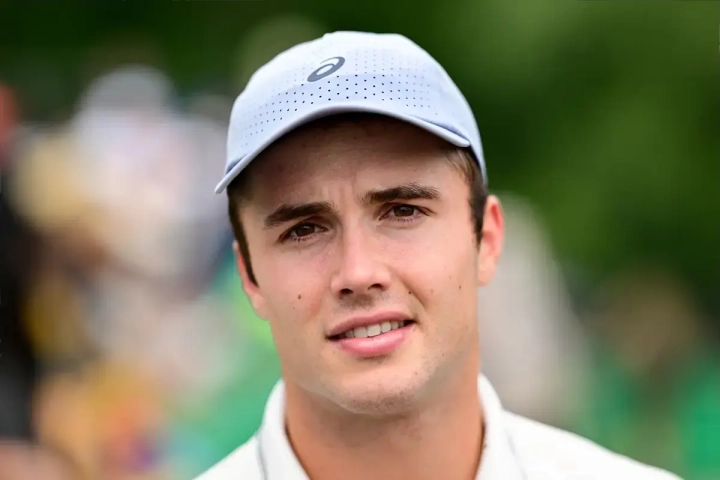
The hallowed lawns of SW19 have witnessed countless narratives of triumph, despair, and sporting immortality. Yet, occasionally, a story emerges that feels almost too perfectly scripted for reality. Enter Arthur Fery. A 23-year-old local boy, who grew up a mere five-minute walk from the All England Club gates, is currently living out the ultimate Wimbledon fantasy. Following his sensational five-set victory over former world No. 3 Grigor Dimitrov yesterday, Fery has catapulted himself from a relatively obscure wildcard to the absolute centrepiece of the British sporting summer.
As the sun sets on the second week of The Championships, the 2026 tournament has a singular home narrative remaining. Fery is officially the last British player left in the singles draw. But this is not merely a story of a plucky underdog making up the numbers; it is an analytical testament to modern resilience, the value of the US college tennis system, and the sheer power of Centre Court momentum.
The Centre Court Classic: Dissecting the Dimitrov Victory
When Arthur Fery stepped onto Centre Court for the first time in his life on Monday, the magnitude of the occasion could easily have overwhelmed him. Across the net stood Grigor Dimitrov, an absolute legend of the game, a former Wimbledon semi-finalist, and a man possessing one of the most aesthetically flawless games in modern tennis.
The encounter that followed will be etched into Wimbledon folklore as a three-hour and 55-minute rollercoaster of shifting momentum and breathless drama. Fery displayed zero signs of stage fright in the opening exchanges. The first set went with serve until 5-5, at which point the Briton capitalised on a brief lapse from the Bulgarian, breaking to love and sealing the set 7-5 with an unreturned booming serve.
However, pedigree often tells in Grand Slam tennis. Dimitrov, operating under the guidance of British coach Jamie Delgado, heavily deployed his trademark backhand slice, disrupting Fery’s rhythm. Dimitrov seized the second set 6-3 after breaking in the eighth game, and meticulously captured the third set 6-4, establishing a formidable two-sets-to-one lead.
For a 23-year-old competing in only his first Grand Slam fourth round, the writing appeared to be on the wall. When Fery went a break down in the fourth set, the Centre Court crowd braced for a valiant but inevitable exit. Instead, they witnessed the birth of a genuine star. Relying on an extraordinary well of mental fortitude, Fery clawed his way back. At 5-4, serving to stay in the set, a double fault from Dimitrov presented an opening. Fery ruthlessly surged to a 40-0 lead and converted his third set point when the Bulgarian steered a volley into the net, taking the set 6-4.
The deciding fifth set was an attritional war, culminating in a nerve-shredding 10-point championship tiebreak. Dimitrov inexplicably suffered a spectacular mid-match slump, losing 11 consecutive points from a 4-3, 15-0 lead, which allowed Fery to completely shift the paradigm of the decider. Displaying skill and courage that vastly belied his experience, Fery secured the tiebreak 10-7, collapsing in disbelief as Dimitrov’s final backhand hit the net. Fery looked to the heavens, and then to the Royal Box, where eight-time champion Roger Federer watched on.
“Where to start? I’ve no words right now,” an emotional Fery addressed the crowd. “First time on this court, five sets against an absolute legend of the game. I grew up five minutes from here… having the support and winning, it’s unbelievable.”
Who is Arthur Fery? The Boy from Down the Road
To understand Fery’s meteoric rise, one must trace his unique developmental path. Born in Sèvres, France, his family moved to London, where he grew up steeped in the local SW19 culture. He attended the prestigious King’s College School in Wimbledon, literally a stone’s throw from the courts where he is currently making history.
While many highly touted British juniors immediately transition to the gruelling lower tiers of the professional circuit, Fery opted for a route increasingly favoured by intelligent modern players: the US collegiate system. Competing in the NCAA for Stanford University, Fery honed his craft in a high-pressure, team-oriented environment. This experience clearly instilled a level of tactical maturity and mental resilience that has been glaringly evident over the past ten days.
Entering this year’s Wimbledon ranked 114th in the world, Fery had previously claimed his first ATP Challenger Tour victory at the Nottingham Open and secured his first Challenger singles title in Barranquilla in August 2025. His grass-court pedigree was quietly building—with a semi-final run at the Lexus Birmingham Open and a quarter-final appearance at the HSBC Championships just weeks prior to arriving at the All England Club. Yet, prior to this fortnight, he had never advanced beyond the second round of a Grand Slam.
Rewriting the History Books: The Statistical Magnitude
Fery’s run is not just an emotional triumph; it is a statistical anomaly that is aggressively rewriting the history books of British tennis. By defeating Dimitrov, Fery secured a litany of historic milestones:
He is only the sixth British man in the Open Era to reach the quarter-finals of Wimbledon.
He joins an elite and highly exclusive club comprising Andy Murray, Tim Henman, Roger Taylor, Greg Rusedski, and Cameron Norrie.
He is the first British wildcard, male or female, to ever reach the quarter-finals of a Grand Slam in the Open Era.
He is the first male player ranked outside the world’s top 100 to reach the quarter-finals at SW19 since a world No. 144 Nick Kyrgios achieved the feat in 2014.
He is just the fifth wildcard in the Open Era to reach the last eight in the Wimbledon men’s singles draw.
Perhaps the most defining characteristic of his tournament thus far has been his refusal to be beaten. In both the third round against Zizou Bergs and the fourth round against Dimitrov, Fery successfully fought back from a two-sets-to-one deficit. Against Bergs, he was a double-break down in the fourth set and a break down in the fifth. Against Dimitrov, he was a break down in the fourth.
“It’s been the story of the tournament for me,” Fery noted. “I was really close to losing in the last round and again today. A break down in the fourth, just trying to keep fighting, to have a good attitude and it paid off.”
The Next Hurdle: A Familiar Foe in Flavio Cobolli
As the euphoria of Monday evening settles, the analytical focus must immediately pivot to Wednesday’s quarter-final. Standing between Fery and a scarcely believable Wimbledon semi-final is Flavio Cobolli. The 24-year-old Italian is the tournament’s 9th seed and arrives with immense pedigree, having recently reached his first Grand Slam final at the 2026 French Open (losing to Alexander Zverev in five sets). Cobolli booked his place in the last eight with a hard-fought 7-5, 7-6, 6-3 victory over Alex de Minaur.
However, Fery will carry a crucial psychological advantage into the contest. The two men have already met at a Grand Slam this season. In January, during the first round of the 2026 Australian Open, Fery produced a masterclass to defeat Cobolli, who was the 20th seed at the time, 7-6 (1), 6-4, 6-1. While Cobolli struggled with a stomach bug during that encounter in Melbourne, Fery completely dictated the terms of engagement.
“It’s going to be a good match regardless,” Fery stated, looking ahead to the clash. “I’m expecting it to be very, very difficult and different to Australia. Completely different conditions. I’m sure he’s going to be at 100 per cent of his capacities here… I played really well in Australia. Felt like I dominated the match. So we’ll use that experience for Wednesday.”
The Local Boy’s Destiny
Arthur Fery is already guaranteed to break into the world’s top 100 following this unprecedented run, fundamentally altering the trajectory of his professional career. Yet, rankings and points feel somewhat secondary to the magic he is currently producing on the grass courts he grew up adjacent to.
For decades, British tennis fans have desperately projected their hopes onto a select few individuals. Fery’s emergence provides a thrilling new protagonist for the national sporting narrative. He possesses the heavy serve, the crisp ball-striking, and most importantly, the tactical intellect required to navigate the perilous waters of Grand Slam tennis.
Whether his journey concludes against Cobolli on Wednesday or extends into the elusive semi-final weekend, Arthur Fery has already won the hearts of the British public. The boy from down the road has firmly arrived on the global stage, proving that sometimes, the most extraordinary fairytales are written right in your own backyard.