New Freedom of Information data obtained by Mums for Lungs has found that over 200,000 children are taken to hospital with breathing difficulties in a survey of 11 major English cities.
The youngest children are most affected. Over 120,000 babies and toddlers aged up to 3 accounting for over half (57%) of those admitted to A&E or hospital.
Children are particularly vulnerable to air pollution because their lungs are still developing and they breathe more air relative to their body size than adults. Exposure to pollutants including nitrogen dioxide and fine particulate matter is associated with respiratory illness and can exacerbate conditions such as asthma.
In the city of Manchester there has been a stark increase in the number of babies and toddlers being admitted, with the numbers rising by 63.9% between 2023 and 2025 from 654 to 1072. Figures are taken from FOIs to the Manchester Foundation NHS Trust.
The decision by then Mayor Andy Burnham to scrap plans for a Clean Air Zone in 2023 raises important questions about whether sufficient action is being taken to sustain improvements and drive pollution levels down.
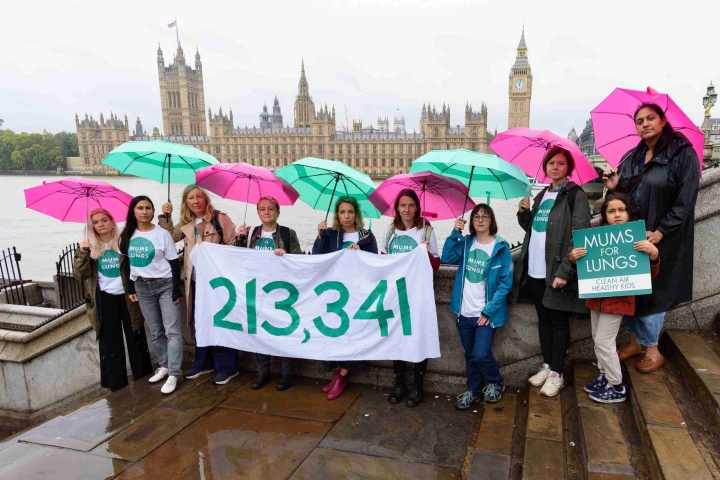
Across the covered NHS trusts, at least 72,661 paediatric respiratory hospital admissions were reported in 2025. A further 140,680 A&E attendances for respiratory conditions were reported where trusts supplied A&E data, bringing the combined total of reported hospital admissions and A&E attendances to 213,341.The figures cover 2025 and provide a snapshot of hospital admissions and A&E attendances for respiratory conditions in the NHS trusts that responded.
In opposition, the Labour Party promised to introduce a legal right to clean air through a Clean Air Act but this was dropped from the party’s manifesto in 2024.
Last week Greater London, Glasgow and Bristol were declared to have been illegally polluted in 2025 by DEFRA. According to the newest methodology by DEFRA Greater Manchester is no longer illegally polluted, despite local authority monitors measuring illegal levels of pollution.
FOI figures obtained by Mums for Lungs show the scale of the pressure respiratory illness is already placing on children and the NHS. For families, those figures represent frightening episodes of children struggling to breathe and repeated trips to hospital.
Alba De Toro Nozal, whose nine-year-old son Eliot has experienced breathing problems since he was a baby, said:
“When Eliot was very small there were times when he simply couldn’t breathe properly, even with his inhalers. We would end up in A&E where he needed a nebuliser. No parent should have to watch their child struggling for breath like that.
“We can’t control the air our children breathe when they walk to school or play outside. That is why we need the Government to use the Budget to invest in cleaner air and give children like Eliot the chance to grow up with healthy lungs.”
Jemima Hartshorn, Mums for Lungs, said:
“Behind every number is a child who is struggling to breathe and a family looking for help. We cannot keep treating dirty air as inevitable or acceptable – our children deserve cleaner air around schools, nurseries, their homes and busy roads, and we need action now. We need to restore funding to tackle air pollution in the Budget and Government to bring down pollution across the country. Let’s be frank, non-essential wood burning and diesel vehicles have got to go. We all deserve to be healthy.”
“London being declared to be illegally polluted again – failing to comply with limits that should have been met 15 years ago. This has to be a wake-up call for our Mayor to continue the work he started which has seen pollution levels fall. We need to ensure we can swap the most polluting diesel vehicles for cleaner options: cars, vans and buses. And Government needs to stand up to industry and ensure non-essential wood burning is phased out without any further delay.”
Dr Dan Cromb, resident paediatric doctor in Lambeth, President of the Royal Society of Medicine’s Paediatric & Child Health Section, London said:
“As a paediatrician I regularly see children struggling to breathe. Air pollution can make respiratory conditions worse and contributes to the burden already being placed on families and NHS services.”
“The Budget is an opportunity for the Government to recognise that clean air is a health investment and to promote active travel as a part of this. Cutting back on measures that reduce pollution may save money on paper today, but the consequences are felt in GP surgeries, A&E departments and hospital wards. Prevention is better for children, better for the NHS and better value for taxpayers.”
Dr Elizabeth Wan, a resident doctor in North London and mother of a child with asthma, said:
“As a local doctor and a mum, these numbers represent so much anxiety, pain and sadness for so many families. Children in London deserve better – they should not be punished with poor health simply because of where they live. We need cleaner air for all of us, and we need it urgently.”
The data includes 20,863 children across the Greater Manchester trusts represented (children admitted and attended A&E); 19,627 across the two Birmingham trusts in the dataset; 12,066 in the Liverpool hospitals and 10,724 in Sheffield.

Greater Manchester members of Mums for Lungs outside No.10 North showcasing the number of children’s admissions and presentations to A&E for breathing issues in 2025. Photo: Sarah Pull
A&E figures are also striking in some individual hospitals. North Middlesex University Hospital recorded 10,393 reported paediatric respiratory A&E attendances in 2025, while Alder Hey recorded 9,525 and University Hospital of Derby and Burton recorded 7,891.
Mums for Lungs is calling for stronger action to reduce children’s exposure to air pollution, including measures around schools and on roads, alongside faster progress towards cleaner air across England.
None of the cities measured currently meets the World Health Organization’s air quality guidelines.
Mums for Lungs is calling for:
• A clear, enforceable pathway towards World Health Organization air-quality guidelines at least in line with the EU,
• Practical measures to reduce traffic-related air pollution, particularly around schools and other places where children spend time, including a transition away from diesel vehicles (cars, vans and buses),
• Action to reduce non-essential domestic wood burning, and a
• Public health campaign to raise awareness of air pollution, its sources and impact on everyone’s health.
Additional Parental Quotes:
Sheffield
Rachel Smedley, parent in Sheffield: “As a mother of three children I am incredibly concerned about air pollution in our city. Our eldest child suffers with chest issues and was under a consultant in the respiratory department for a few years. His chest issues always get worse in the colder months when domestic wood burning significantly worsens the air quality where we live. People still don’t seem to realise how polluting wood burning is. It’s hard not being able to protect your children from this. Sometimes I end up calling them in from the garden because the smoke is so strong which is sad as playing outside is really good for them. But I know it seeps into our house too, even with all the windows and doors closed. It upsets me a lot and makes me want to move but it seems to be a big problem in so many places.”
Birmingham
Kirsten de Vos, parent in Birmingham: “17,465 children in Birmingham were admitted to hospital with breathing problems last year. Behind that figure are thousands more children struggling to breathe. In Birmingham, air pollution remains high, with inner-city areas where many of our most deprived communities live consistently failing to meet WHO air quality guidelines. We’re calling on Birmingham City Council to act to reduce air pollution. Alongside traffic measures such as the Clean Air Zone, this must include tackling wood burning and garden waste fires. Clean air isn’t a luxury. It’s a basic human right.”
Greater Manchester
Liz Godfrey, Mums for Lungs Regional Coordinator and parent in Greater Manchester:
“For another year, thousands of children were struggling to breathe and were admitted to hospitals across Greater Manchester. Instead of learning at school, playing with friends and having dinner at home children were choking and needing urgent medical care. Mayor Bev Craig and our Prime Minister must take immediate action to protect children where they live, learn and play and reduce air pollution – the Bee Network alone is not enough. We desperately still need better public transport, cleaner freight and less wood burning across Greater Manchester.”
London
Denise Delaney, parent in Wandsworth: “I am deeply concerned about the impact of air pollution on health, especially for my children. Recent experience has shown me that even in a central area in London, it is challenging to find both clean routes and schools supportive of active family travel and accommodating family box/cargo bikes. The youngest residents of London deserve a healthier place to live, and we can deliver that through policy change and the decisions we all make everyday.”
Amy Milne, parent in Greenwich: “It is not surprising that so many children have been admitted to hospital for respiratory illnesses last year in London. Many sources of air pollution are unnecessary and preventable. It is so important to raise public awareness of sources such as wood burning and idling so that local air quality improves. The air we breathe is a shared resource that we need to take care of.”
Preema Patel, mother of Violet (3), South East London said: “Last year, my daughter was admitted to hospital 11 times with breathing difficulties. As a mother, it is heartbreaking to watch your child struggle to breathe, need oxygen and be too breathless to simply play. Knowing that everyday pollutants can be reduced through greater awareness and simple actions is why I feel so passionately that we must act now. We need to take greater responsibility for the air our children breathe and recognise that even small changes can make a real difference. It’s time we made their health a priority.”
Alice P, parent in Greenwich, “We want local parents in Greenwich to know about the impact of poor air quality on their families, last year there were 4288 paediatric respiratory presentations and admissions at Queen Elizabeth in Woolwich alone. That is a lot of scary trips for children and their families. Children don’t get to choose the quality of the air they breathe and the list of negative health impacts caused as a result of poor air quality is long and depressing”