
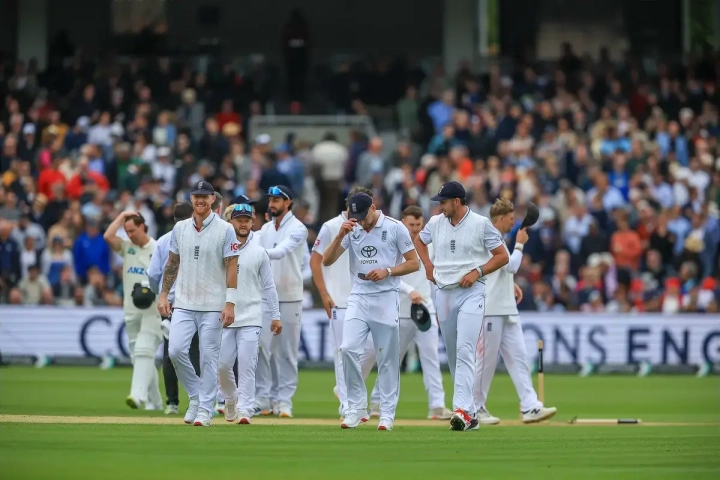
As Gus Atkinson sent Matt Henry’s middle stump cartwheeling out of the ground on the fourth morning at Lord’s, a sense of collective relief washed over the England camp.
Following a gruelling winter that saw them dismantled 4-1 in the Ashes, Ben Stokes’ side desperately needed to start the 2026 Test summer with a victory. They achieved exactly that, securing a comprehensive 115-run win over New Zealand to go 1-0 up in the three-match series.
However, beneath the surface of the celebrations lies a profoundly unsatisfactory contest. The 150th Test match at the Home of Cricket was defined not by Bazball bravado, but by a woefully underprepared pitch that turned the match into an utter lottery.
A Pitch Under Fire
The Lord’s square, recently relayed with the hope of generating pace and bounce, instead produced a surface where survival felt impossible.
The statistics are staggering: the match was concluded in just 166 overs, making it the second-shortest Test at Lord’s and the third-shortest in history where all 40 wickets fell. A wicket tumbled every 24.9 balls, the fastest rate in an English Test since 1907. Strikingly, 24 of the 40 dismissals were either bowled or lbw, a direct consequence of the wildly unpredictable, skidding bounce that trapped batters on the crease.
Neither captain even bothered to bowl a spinner, making this the first Test in England since 1988 where the slow bowlers were entirely redundant.
Former England captain Michael Vaughan summarized the general sentiment perfectly: “I can’t judge the batting unit on today, it’s been a bit of a lottery. On that surface, you need a bit of luck… The MCC would be the first to admit that there’s something wrong with the square.”
The Final Morning: Atkinson Shines at the Home of Cricket
Resuming on Day 4 at a perilous 55 for 5 and chasing an academic target of 254, New Zealand needed a miracle.
That miracle was quickly extinguished by Josh Tongue. In the first full over of the day, Tongue pinned Tom Blundell lbw with a delivery that scooted disastrously low off a good length. Blundell didn’t even bother reviewing.
For a brief period, Glenn Phillips and Devon Conway threatened to mount a resistance. Recognizing that defending was a futile exercise on this deck, Phillips counter-attacked brilliantly. He hooked Tongue for six, slashed Atkinson through the covers, and finished unbeaten on 44 from 52 balls, making him the top scorer in the match with an aggregate of 78 runs.
Conway (41) also dug in, despite being dropped at second slip by Harry Brook. The pair shared a 53-run stand for the seventh wicket, briefly forcing England into a defensive field setting.
However, Ben Stokes broke the partnership with a crucial intervention. Angling the ball into Conway from around the wicket, the Kiwi opener clipped a leading edge that was spectacularly snatched inches off the turf by Jacob Bethell at gully.
From there, Gus Atkinson took absolute control.
Putting behind a concussion scare earlier in the week, Atkinson cranked his pace up to 90mph. He had Nathan Smith caught behind, Kyle Jamieson softly chipping to midwicket, and finally castled Henry to seal the victory.
The 5-30 return marked Atkinson’s fifth Test five-for, and his fourth at Lord’s. The Surrey speedster has now taken a mind-boggling 26 wickets at Lord’s across his last three matches at an average of 9.88.
Lessons from the Chaos
Despite the win, it is incredibly difficult to draw substantial conclusions regarding England’s post-Ashes rebuild given the chaotic nature of the surface.
- The Robinson Return: The most significant positive for England was the sensational return of Ollie Robinson. Operating with suffocating accuracy, Robinson took 5-39 in the first innings, including a breathtaking triple-wicket maiden, and picked up two more in the second. As he noted post-match, the challenge now is maintaining this fitness and form.
- The Debutant: Emilio Gay demonstrated excellent temperament on his debut. His second-innings 57 was the highest individual score of the match and provided crucial breathing room for England.
- New Zealand’s Sloppiness: The Black Caps will rue a wildly uncharacteristic performance. Dropping five crucial catches in a low-scoring game ultimately proved fatal, compounding the loss of key bowler Matt Henry to a back spasm.
England now have a nine-day break to reflect and recuperate before the second Test commences at The Oval on June 17, where a much truer surface is desperately required for a genuine contest between bat and ball.