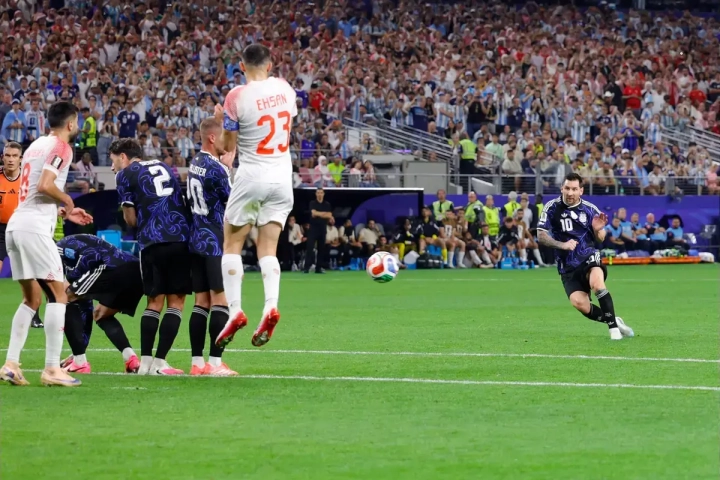
Argentina completed a flawless Group J campaign with a controlled 3-1 victory over Jordan in Dallas, a result that underlined both the depth of Lionel Scaloni’s squad and the enduring brilliance of Lionel Messi. The world champions had already secured their place in the knockout stage before kick-off, but there was no sense of drift or complacency in the way they approached their final group match. Even with a heavily changed starting line-up, Argentina were sharp, composed and ruthless enough to finish the opening phase with three wins from three, while Jordan departed their first World Cup with pride, frustration and a clearer understanding of the level required at this stage.
Giovani Lo Celso opened the scoring with a beautifully struck free-kick in the 19th minute, Lautaro Martínez doubled Argentina’s lead from the penalty spot before half-time, and although Mousa Al-Tamari gave Jordan a moment of hope early in the second half, Messi came off the bench to seal the win with another free-kick in the 80th minute. It was a goal that carried historical weight as well as competitive significance, making him the first player to score in seven consecutive World Cup matches and extending his remarkable tournament record at the age of 39.
The match began with Argentina looking immediately comfortable in possession. Scaloni had made nine changes to the side that had beaten Austria, with Messi among those initially rested, but the rhythm of the team remained familiar. Argentina circulated the ball patiently, drew Jordan out of shape, and used the width of the pitch to create space between the lines. Jordan, already eliminated before the game, had no reason to play with fear and began with energy, yet they were quickly forced to defend for long spells as Argentina established control.
Lo Celso, handed a rare opportunity to start on the World Cup stage, was central to Argentina’s early authority. His movement gave the team balance, his passing helped connect midfield and attack, and his set-piece quality delivered the breakthrough. Before scoring, he had already threatened with clever runs into advanced positions, including one finish that was ruled out for offside. Rather than retreat from the spotlight, he continued to demand the ball and set the tempo.
The opening goal arrived from a free-kick just outside the area. Lo Celso shaped his effort with precision, lifting the ball beyond the wall and leaving the Jordan goalkeeper with little chance. It was a goal of elegance and confidence, but it also felt significant for Argentina because, until then, Messi had dominated their scoring in the tournament. Lo Celso’s strike served as a reminder that this squad contains quality beyond its captain, a point Scaloni will have welcomed as the knockout stage approaches.
Jordan tried to respond quickly, but the pattern of the match remained difficult for Jamal Sellami’s side. Argentina’s midfield, led by the calm distribution of Leandro Paredes and the energy of Exequiel Palacios, kept forcing Jordan backwards. Whenever Jordan did regain possession, they found themselves pressed quickly and left with limited time to build attacks. Their best moments came when Al-Tamari could receive the ball in space and drive directly at defenders, but those openings were rare during the first half.
Argentina’s second goal came in the 31st minute after another spell of pressure forced Jordan into a costly mistake. Lautaro Martínez took responsibility from the penalty spot and finished with authority, sending the goalkeeper the wrong way and giving Argentina a 2-0 lead that reflected their superiority. For Martínez, the goal was particularly important. He had worked hard across the front line, pressing defenders and making selfless runs, and the penalty gave him the reward his performance deserved.
At that stage, Jordan looked in danger of being overwhelmed. Argentina were not playing at maximum intensity, but their technical level and decision-making were consistently a step ahead. Every pass seemed to have purpose, every player appeared comfortable receiving the ball under pressure, and the world champions were able to manage the game without needing to overextend themselves. Jordan, by contrast, were working hard simply to stay connected as a defensive unit.
Yet the second half showed why Jordan can leave the tournament with dignity. Rather than allowing the game to drift away, Sellami’s side emerged with renewed belief. They pressed with more aggression, pushed their wide players higher and looked to create moments of disruption. That approach brought reward in the 55th minute when Al-Tamari, introduced from the bench, found the net to reduce the deficit. His goal gave Jordan their loudest moment of the night and ensured they had scored in every game of their debut World Cup campaign.
Al-Tamari’s finish briefly changed the energy inside the stadium. Argentina, who had looked so secure, suddenly had to sharpen again. Jordan’s supporters sensed an opportunity, and their players began to attack with greater courage. For a short spell, the match became more open. Jordan pushed bodies forward, tried to force hurried clearances and looked for another moment of inspiration from their most dangerous attacker.
That period was important for Argentina too. It tested the concentration of a rotated side and asked whether the players brought in by Scaloni could manage pressure in a match that still mattered for momentum. The response was mature. Argentina slowed the game, regained control of possession and denied Jordan the chance to turn hope into sustained pressure. Nicolás Tagliafico and Nicolás Otamendi brought authority to the back line, while the midfield began to take the sting out of Jordan’s attacks by keeping the ball for longer phases.
Then came the moment the crowd had been waiting for. Messi was introduced in the second half, and the mood of the match shifted almost instantly. Even when Argentina are already in control, his presence changes the emotional temperature of a game. Jordan’s defenders became more cautious, Argentina’s attackers found sharper combinations, and every touch from the captain carried anticipation.
His goal arrived 10 minutes from time after he was fouled just outside the penalty area. The position was ideal for him, and everyone in the stadium knew what could follow. Messi stood over the ball with familiar calm, measured the angle, and sent a low free-kick through the defensive barrier and into the corner. It was not simply the goal that mattered, but the inevitability of it. The technique, the timing and the composure all belonged to a player still defining the biggest matches even deep into the final phase of his career.
That strike made it 3-1 and ended Jordan’s hopes of a late fightback. It also added another extraordinary line to Messi’s World Cup story. He had already built a tournament full of goals, influence and records, but scoring in seven consecutive World Cup matches placed him in territory no player had previously reached. At 39, after winning the trophy in Qatar and returning to defend it four years later, his ability to continue shaping games at this level remains remarkable.
Scaloni’s post-match mood was one of satisfaction rather than celebration. He was pleased with the win, pleased with the professionalism of the players who came into the side, and clearly encouraged by the fact that Argentina had managed to rotate heavily without losing structure. He has spoken often about the importance of the collective, and this match strengthened that message. Argentina are not simply relying on Messi to rescue them; they are built on a stable system, trusted relationships and a squad capable of adapting.
The Argentina manager was also full of admiration for Messi, though even he appeared to be running out of new ways to describe his captain’s achievements. For Scaloni, the most striking thing remains Messi’s focus on the team rather than individual milestones. The record will dominate headlines, but inside the Argentina camp the priority is maintaining rhythm, humility and sharpness before the knockout rounds. The meeting with Cape Verde will bring different challenges, and Scaloni made clear that Argentina cannot afford to assume anything simply because of their status as champions.
Sellami, meanwhile, was left to reflect on a difficult but valuable World Cup experience for Jordan. His side lost all three group matches, yet they were not passive participants. They scored in every game, competed with spirit and gave their supporters moments to cherish. Against Argentina, the gulf in experience and quality was obvious, but so too was Jordan’s willingness to keep playing even after falling behind by two goals.
The Jordan manager viewed the mistakes as part of the learning process. At this level, errors are punished quickly, and Argentina exposed every hesitation with ruthless calm. Sellami recognised that his team’s inexperience showed at key moments, particularly in their defensive organisation and decision-making under pressure, but he also believed the tournament could become a foundation for future growth. For a nation appearing at its first World Cup, simply sharing the stage with the world champions was a landmark; scoring against them gave the night an additional note of pride.
Tactically, the match highlighted Argentina’s versatility. Without Messi from the start, they still created chances through structure rather than improvisation. Lo Celso’s intelligence between the lines gave them a different creative rhythm, Lautaro Martínez provided penalty-box presence, and the supporting runners ensured Jordan’s defence was rarely settled. When Messi entered, Argentina did not need to change identity; they simply added the game’s greatest problem-solver to an already functioning side.
Jordan’s best route was always going to be through quick transitions and individual moments from Al-Tamari. His goal showed exactly why he remains such an important figure for them. He has the pace, balance and confidence to disturb stronger opponents, and his strike ensured Jordan did not leave quietly. But Argentina’s control of midfield limited how often he could influence the contest, and once Messi restored the two-goal margin, Jordan’s challenge effectively ended.
For Argentina, this was the ideal type of group-stage finale. They rested key players, gave minutes to squad members, avoided major drama and still won convincingly. Their defensive record was slightly blemished by Jordan’s goal, the first they had conceded in the tournament, but that may even serve as a useful reminder that standards cannot slip. In knockout football, small lapses can decide everything.
The bigger picture remains extremely encouraging for the holders. Three matches, three victories, a perfect points total and Messi leading the attack with extraordinary efficiency. Yet the most ominous sign for rivals may be that Argentina are now getting contributions from others. Lo Celso’s goal, Lautaro’s penalty and the performances of the rotated players all suggest Scaloni has options, not just stars.
Jordan’s campaign ends, but their World Cup story should not be dismissed as failure. They arrived as debutants, faced elite opponents and experienced the unforgiving reality of football’s biggest tournament. There were moments of naivety, but there were also signs of character. For their supporters, the sight of Al-Tamari scoring against Argentina will endure long after the disappointment of elimination fades.
When the final whistle sounded in Dallas, Argentina walked off with the calm assurance of a side that knows bigger tests are coming. Jordan left with applause, bruised but not broken. The champions had done what champions do: managed the occasion, punished mistakes, controlled momentum and found magic when required. And, once again, Messi provided the image that will travel around the world — standing over a free-kick, shaping history with his left foot, and reminding everyone that even in the closing chapters of his career, he remains capable of making the World Cup feel like his stage.