Spain moved into the last 16 of the World Cup with a polished and commanding 3-0 victory over Austria, producing one of their most complete performances of the tournament and underlining why they remain among the strongest contenders still standing. Mikel Oyarzabal scored twice, Pedro Porro added his first international goal, and Luis de la Fuente’s side controlled the contest from start to finish with the confidence, patience and sharpness expected of a team growing into the knockout stage.
This was a night when Spain did not simply win; they imposed themselves. From the early exchanges, they played with authority, circulating the ball quickly, stretching Austria across the pitch and refusing to allow Ralf Rangnick’s side any rhythm in possession. Austria arrived with the hope of frustrating Spain, staying compact and looking for moments on the break, but they spent long periods pinned deep inside their own half, forced to defend wave after wave of Spanish pressure.
Spain’s dominance was reflected not only in the scoreline but in the pattern of the match. They were quicker to loose balls, more composed in tight spaces and far more dangerous in the final third. Austria defended bravely at times, with David Alaba and Alexander Schlager both heavily involved, but the pressure eventually told.
The breakthrough came in the 36th minute when Marc Cucurella supplied Oyarzabal, who finished clinically to give Spain the lead their performance deserved. Until that point, Austria had survived through organisation and last-ditch defending, but once Spain moved in front, the game became even more difficult for them. De la Fuente’s team were able to settle further, drawing Austria out and then exploiting the spaces that began to appear.
Lamine Yamal was again one of Spain’s most eye-catching attacking outlets. His directness, balance and willingness to take defenders on gave Austria constant problems, while Dani Olmo, Pedri and Rodri helped Spain dictate the tempo through midfield. Austria found it almost impossible to sustain pressure, with Spain’s structure allowing them to recover possession quickly whenever attacks broke down.
There was also frustration for Spain before the goals started to flow. Cucurella thought he had scored, only for the effort to be ruled out following an infringement involving goalkeeper Schlager. Rather than allowing that moment to disrupt them, Spain maintained their control and continued to push Austria back. It was a sign of their maturity that they did not rush or become anxious. They simply kept moving the ball, probing the defensive line and waiting for the next opening.
Austria’s best moments were limited. Sasa Kalajdzic had a headed opportunity after Austria tried to go more direct, but clear chances were rare. Spain’s defensive line, led by Pau Cubarsí and Aymeric Laporte, stayed composed and aggressive, while Unai Simón was protected superbly. Austria failed to register a shot on target, a statistic that summed up Spain’s defensive authority as much as Austria’s attacking struggles.
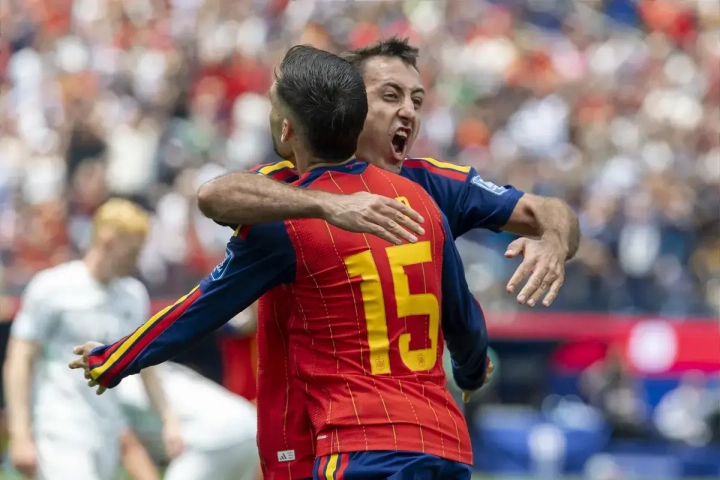
The second goal arrived in the 66th minute and effectively ended the contest. Álex Baena delivered a fine ball into the area and Pedro Porro arrived to head home from close range. For the Tottenham full-back, it was a memorable moment: his first goal for Spain and a reward for an energetic display on the right side. Spain’s full-backs were important throughout, with Porro and Cucurella both offering width, defensive security and attacking quality.
Austria continued to fight, but the match was slipping away. Alaba produced a notable goal-line clearance to deny Yamal, preventing the scoreline from becoming even heavier, and Schlager made several saves to keep Austria within reach for as long as possible. Yet Spain never looked in serious danger. Even when they eased the tempo, they remained in control.
Oyarzabal completed the scoring in the 89th minute, again benefiting from Cucurella’s service before applying another assured finish. It capped an excellent individual night for the Real Sociedad forward, who has become increasingly influential in Spain’s campaign. His movement, intelligence and calmness in front of goal gave Austria problems all evening, and his two goals were the decisive touches in a performance built on collective superiority.
After the match, Oyarzabal said he was happy to have helped Spain through another round and described Austria as a physical opponent who had made the match complicated. De la Fuente also praised Spain’s level, saying great teams step up when required and that his side had come close to perfection.
For Austria, the defeat marked the end of their tournament. Rangnick’s side had shown spirit to reach the knockout stage, but this was a step too far against a Spain team operating with greater technical quality and sharper attacking movement. Austria were organised for long spells, but they could not get enough possession, could not threaten Simón, and could not prevent Spain from turning control into goals.
Spain now advance with momentum, confidence and another clean sheet. Their next test will be against the winner of Portugal v Croatia, a fixture that promises a far sterner examination. But on this evidence, Spain will approach the last 16 believing they have the balance required to go deep: defensive discipline, midfield control, wide threat and forwards capable of finishing the chances their system creates.
This was not a chaotic knockout victory built on nerves or fortune. It was measured, professional and increasingly ruthless. Spain looked like a side comfortable with expectation and ready for the bigger challenges ahead. Austria were beaten by a better team, and Spain marched on with the look of a squad whose tournament is beginning to gather real force.